In this project, I designed and fully electromagnetic (EM) simulated a bow-tie antenna using AWR Microwave Office. My goal was to analyze its impedance matching, bandwidth, and radiation characteristics, and to understand how its geometry affects performance. This project was completed as part of an applied electromagnetics course and gave me hands-on experience with practical antenna design and full-wave EM simulation tools.
Background
The bow-tie antenna is a planar evolution of the biconical antenna, originally developed for wideband operation. By flattening the biconical geometry into two triangules, the antenna becomes much easier to make while keeping its broadband behavior.
Historically, bow-tie antennas became popular for UHF television reception due to their wide bandwidth. Today, they are commonly used in ultra-wideband (UWB) and wireless systems such as Wi-Fi, where compact size, linear polarization, and broadband performance are important.
This is why I chose the bow-tie antenna for my analysis for studying how antenna geometry influences bandwidth and radiation behavior.
Bow-Tie Antenna Geometry and Sizing
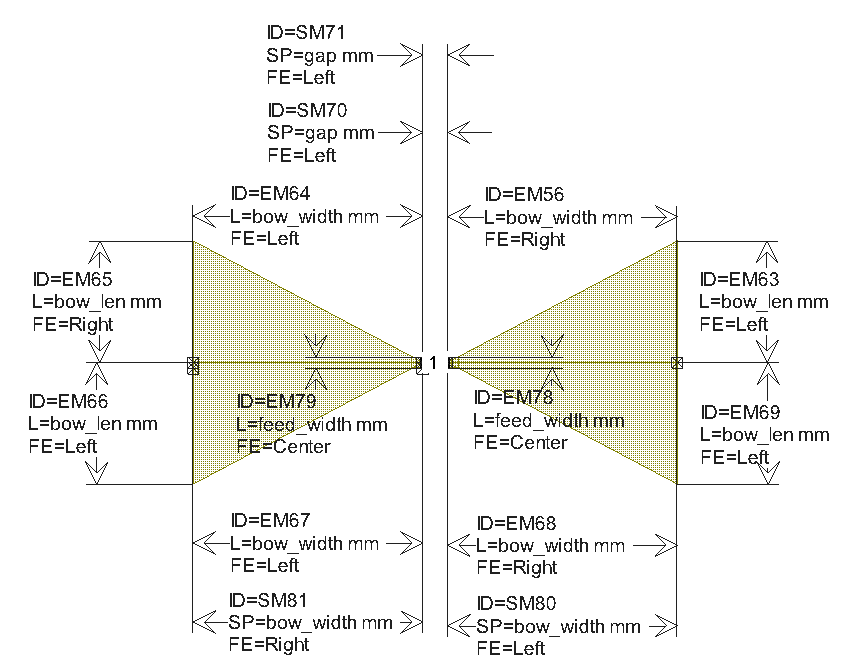
I parameterized the bow-tie antenna using a triangular geometry defined by a fixed side length and opening angle. The main design parameters I used were:
- Triangle angle (α) – controls how “open” the bow-tie is
- Bow length – half the overall width of the antenna
- Feed gap – distance between the two triangular arms
Based on empirical antenna design rules, the effective length of the bow-tie is approximately 0.32λ, while the gap is kept small (around 0.01λ) to maintain good feeding characteristics. The bow length and angle were treated as tuning parameters and optimized through simulation rather than analytical formulas.
Simulation Setup in AWR Microwave Office
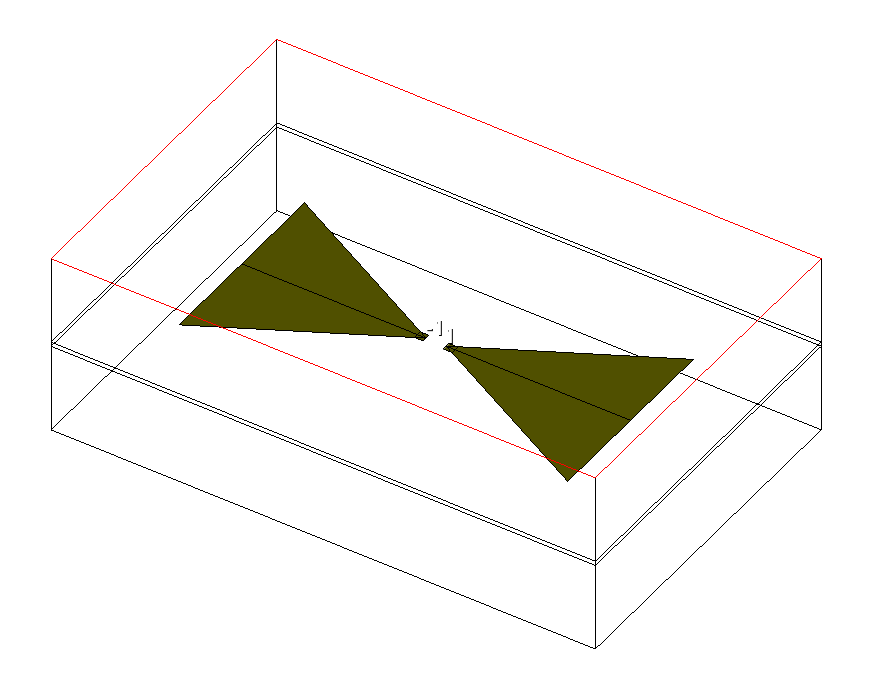
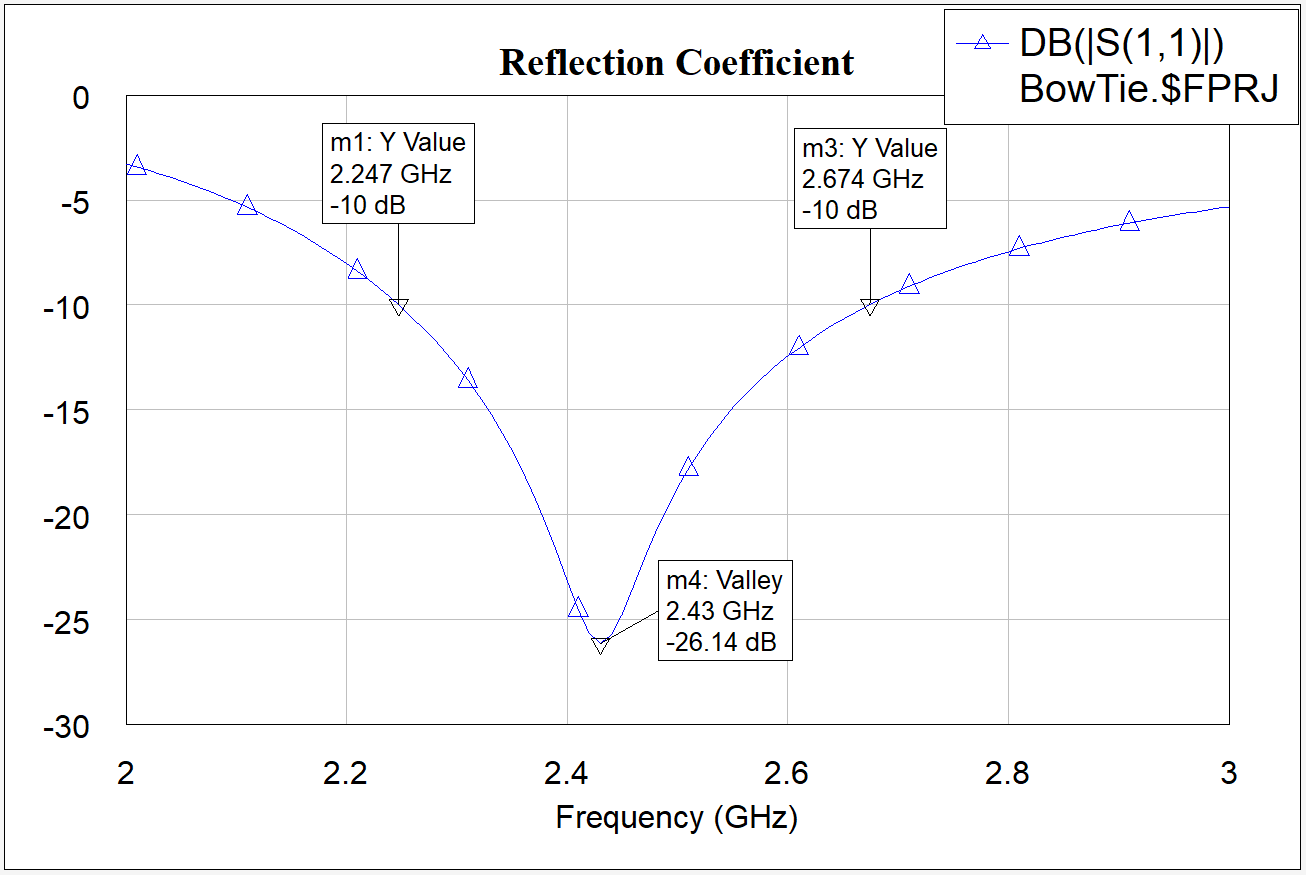
I implemented the antenna in AWR Microwave Office using the AXIEM EM solver. The antenna was designed to operate at a target frequency of 2.45 GHz, which is commonly used for Bluetooth and Wi-Fi applications.
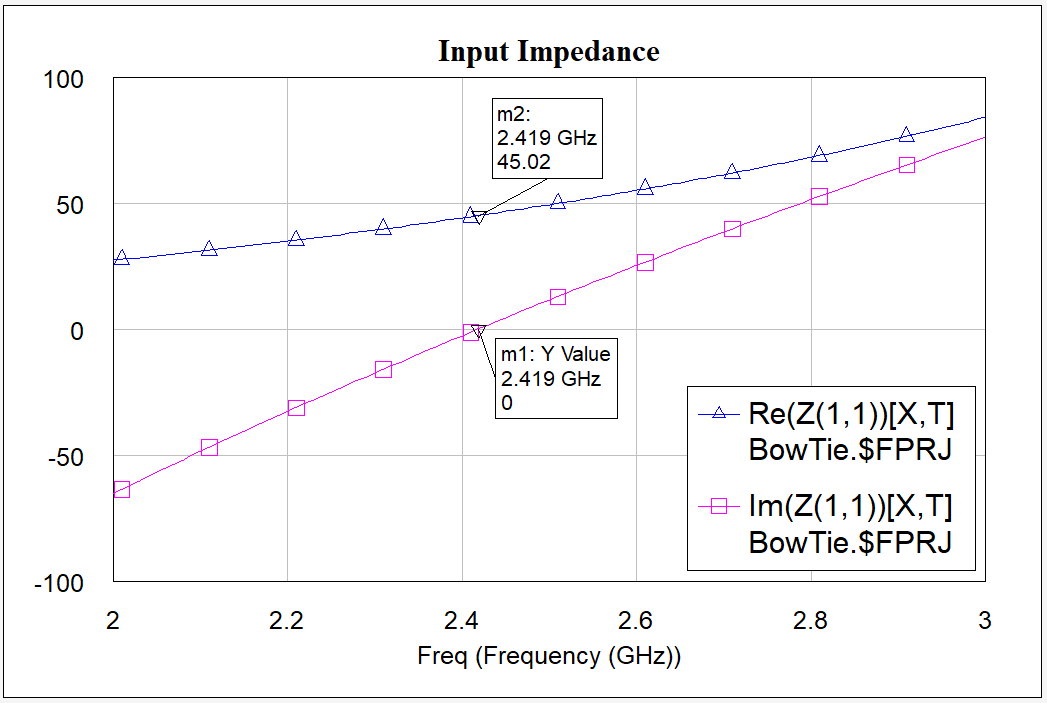
After sweeping the design parameters, I found that the following values provided excellent impedance matching.
- α = 55.78°
- Bow length = 10.85 mm
- Gap = 2.2 mm
At these values, the antenna was very closely matched to a 50 Ω feed line at the target frequency.
Antenna Bandwidth
One of the main advantages of the bow-tie antenna is its wide bandwidth. From the simulated reflection coefficient, I measured a −10 dB bandwidth of approximately 427 MHz, which is very large compared to a traditional dipole.
For comparison, a typical dipole has a bandwidth of around 75 MHz while something like Bluetooth Low Energy (BLE) requires roughly 90 MHz. My designed antenna easily covers this range.
Radiation Pattern Analysis
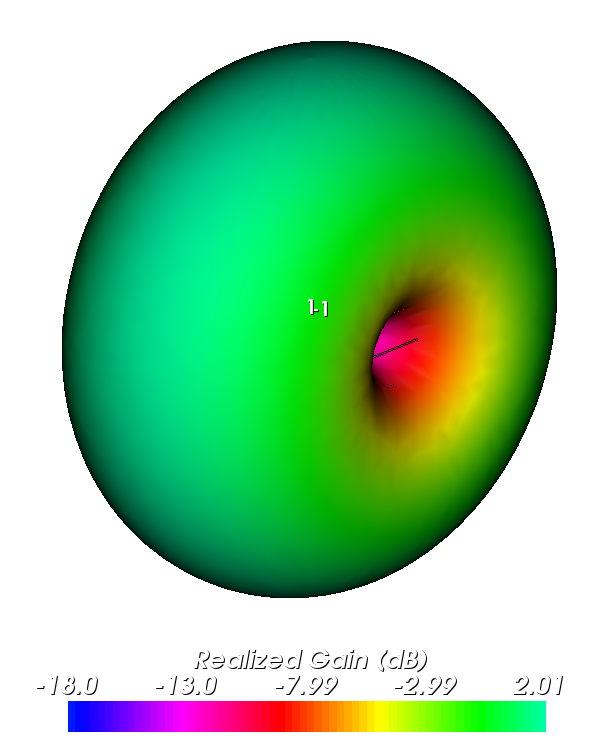
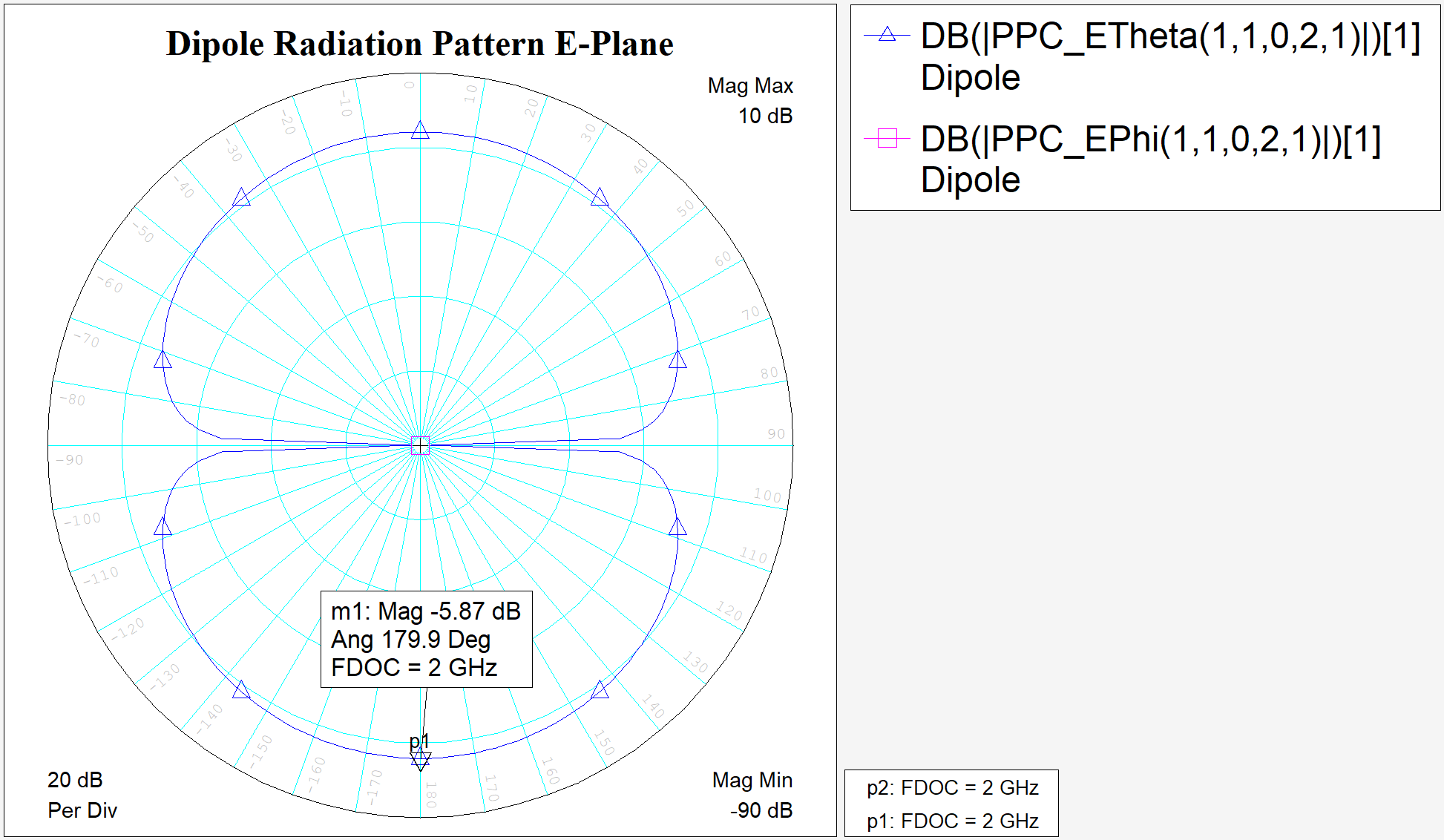
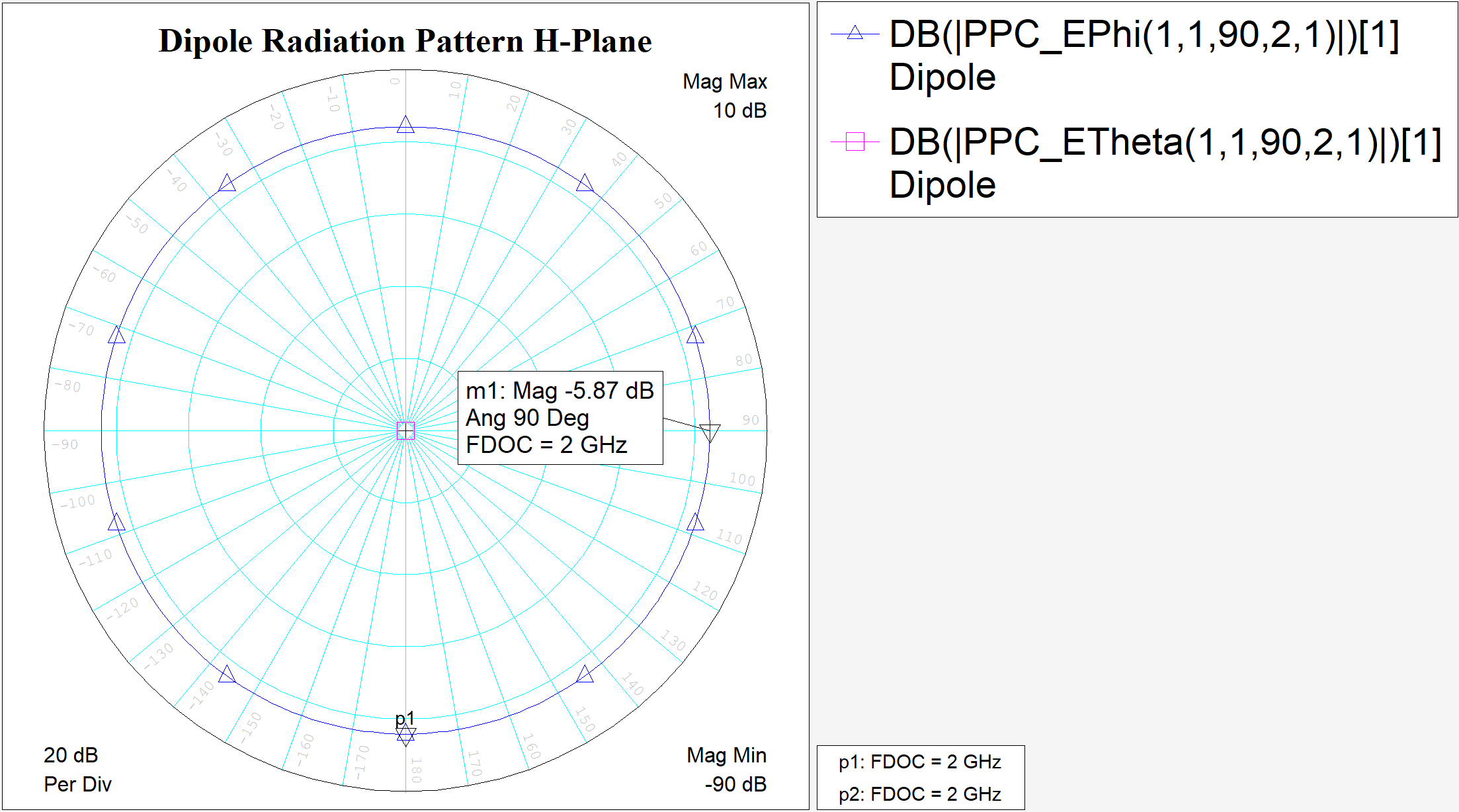
To better understand how the bow-tie behaves as its angle changes, I analyzed its radiation patterns and compared them to a planar dipole.
When the triangle angle α approaches 0°, the bow-tie effectively behaves like a planar dipole. To make a fair comparison, I created a separate planar dipole model with similar length and gap dimensions and simulated it under the same conditions.
By directly comparing the reflection coefficients of the two antennas, the benefit of the bow-tie geometry became very clear as the Bow-tie antenna had ~427 MHz bandwidth while the equivalent planar dipole had ~146 MHz of bandwidth.
This confirmed that increasing the antenna’s effective width through the triangular shape significantly improves impedance bandwidth.
Conclusion
By fully designing and analysizing the bow-tie antenna using full-wave EM simulation, I got my first glimpse into the world of antenna design. Through parameter sweeps and radiation analysis, I basically confirmed the theory studied throughout this course of how broad geometry antennas achieves much wider bandwidth than dipoles.
I got to do things like practical antenna sizing and tuning, impedance matching, and interpreting EM simulation results into things like radiation patterns, all things that are applicable in real world applications. It really was an incredible experience designing this antenna and was one of the highlights of my degrees.